Vibration sensors
Vibration sensors continuously measure how your pumps, motors and compressors vibrate. That way you see bearing damage, imbalance and misalignment coming in time. Ronds supplies seven models: wired, wireless and portable.
Flexible and fast
Wireless vibration sensors
Wireless vibration sensors are installed without cabling. That makes them quick to fit, including on measurement points that are hard to reach. They are ideal for monitoring a large number of machines quickly, without cable trays or extra cabinets.
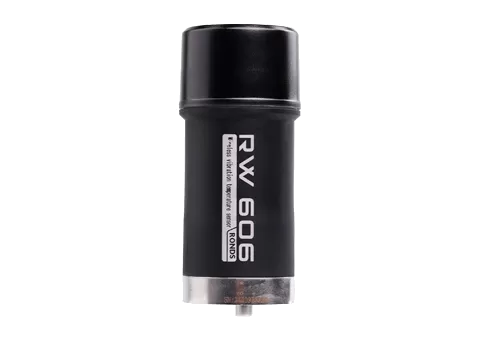
Tri-axial vibration and temperature sensor, (M) with RPM recognition.
View product arrow_forward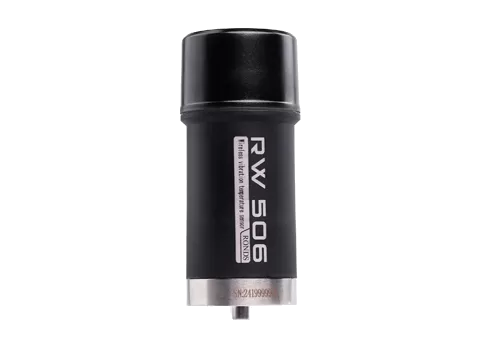
Uni-axial vibration and temperature sensor, (M) with RPM recognition.
View product arrow_forwardSeveral wireless models are available with ATEX/IECEx certification. The RW606(M) and RW506(M) are certified up to and including ATEX Zone 0, the most demanding safety class.
Maximum precision
Wired vibration sensors
Wired vibration sensors have a fixed, continuous connection. Choose this version for your most critical machines, where you do not want to miss a single measurement.
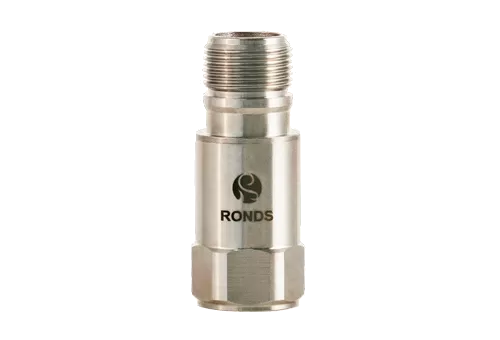
Cylindrical, top connection. Optionally with temperature measurement (T).
View product arrow_forward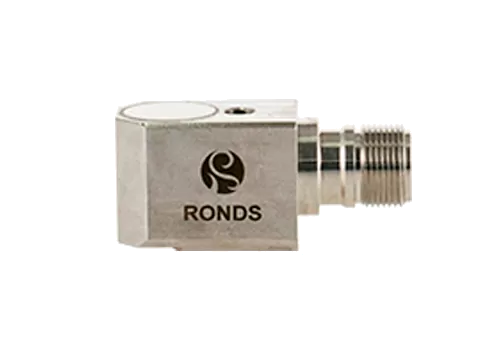
Rectangular, side connection. Optionally with temperature measurement (T).
View product arrow_forward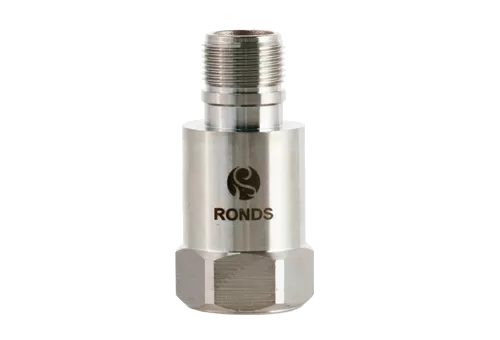
Low frequency, slow running. Optionally with temperature measurement (T).
View product arrow_forward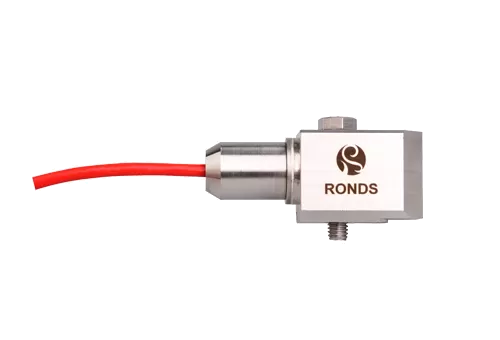
Integrated cable, for damp environments. Optionally with temperature measurement (T).
View product arrow_forwardWired vibration sensors connect to a data collector, such as the RH2000 with 8 to 24 channels.
Periodic measurements
Portable vibration sensor
Are there machines without fixed sensors? Then you measure those during an inspection round with a portable device.
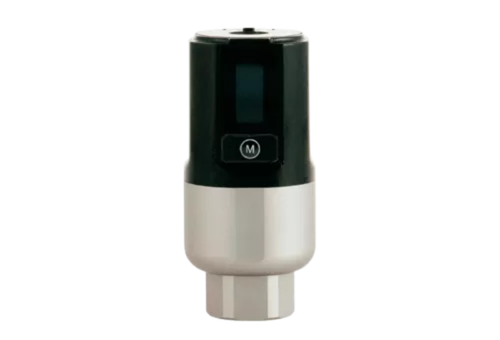
Measurement rounds along machines without fixed sensors, with upload to SuperCare.
View product arrow_forwardAll vibration sensors compared
Seven models side by side. The values come from the datasheets; on each product page you can request the full specifications.
| Model | Type | Measuring direction | Technology | Also measures | Frequency range | Ambient temperature | ATEX | Suitable for |
|---|---|---|---|---|---|---|---|---|
| RW606(M) | Wireless | Tri-axial | Piezo + MEMS | Temperature, running speed | Piezo 2 Hz to 20 kHz, MEMS 0.1 Hz to 1 kHz | -40 to +70 °C | Ex ia IIC T4 Ga, up to Zone 0 | Monitoring many machines quickly, complex fault patterns |
| RW506(M) | Wireless | Uni-axial | Piezo | Temperature, running speed | 2 Hz to 20 kHz | -40 to +70 °C | Ex ia IIC T4 Ga, up to Zone 0 | Standard measurement points without cabling |
| RH103(T) | Wired | Uni-axial | Piëzo (IEPE) | Temperature (T version) | 0.4 Hz to 15 kHz | -55 to +125 °C | Optional, Ex ia IIC T4 Ga | Cylindrical, top connection |
| RH104(T) | Wired | Uni-axial | Piëzo (IEPE) | Temperature (T version) | 0.4 Hz to 10 kHz | -55 to +125 °C | Optional, Ex ia IIC T4 Ga | Rectangular, side connection, little mounting height |
| RH113(T) | Wired | Uni-axial | Piëzo (IEPE) | Temperature (T version) | 0.1 Hz to 10 kHz | -55 to +125 °C | Optional, Ex ia IIC T4 Ga | Low frequencies, slow-turning machines |
| RH104C(T) | Wired | Uni-axial | Piëzo (IEPE) | Temperature (T version) | 0.4 Hz to 10 kHz | -55 to +125 °C | Not standard, Ex ia IIC T4 Ga | Damp environments, fixed cable |
| RH517 | Portable | Uni-axial | See datasheet | Temperature | 2 Hz to 10 kHz | -20 to +60 °C | Ex ib IIC T4/T3 Gb, up to Zone 1 | Measurement rounds along machines without fixed sensors |
The six fixed-mount sensors have IP68 protection and are therefore dust- and waterproof; the portable RH517 is IP65. The wireless models run on a 19 Ah lithium battery, the wired models on IEPE power via the data collector. The frequency range of the fixed sensors applies at ±3 dB. On each product page you can request the datasheet with the full specifications.
Which vibration sensor should you choose?
The right model depends on your machine, the environment and how critical the installation is. Work through these four questions:
Wireless or wired vibration sensor?
Do you want to monitor many machines quickly, or are the measurement points in awkward places? Then choose a wireless vibration sensor. Is it a critical machine where you want a continuous signal stream? Then choose a wired vibration sensor.
Measuring uni-axial or tri-axial?
A uni-axial vibration sensor measures in one direction. A tri-axial vibration sensor measures in three directions at once: horizontal, vertical and axial. That gives a more complete picture, especially for misalignment and other complex fault patterns.
Does the machine turn slowly?
On slow-turning machines, such as agitators or large fans, the relevant vibrations sit in a low frequency range. The RH113(T) was developed specifically for low frequencies.
Do you work in an explosive or wet environment?
In ATEX zones you choose a certified version. The wireless RW606(M) and RW506(M) are even permitted in Zone 0. For damp environments the RH104C(T) with integrated cable is the best choice.
Twijfelt u? Contact us and we will advise you free of charge on the right vibration sensors for your machines.
What does a vibration sensor measure?
A vibration sensor measures the acceleration of the machine surface. From that signal the software calculates vibration velocity (mm/s) and displacement, and envelope analysis makes early bearing damage visible. Because the Ronds sensors also measure temperature, you see overheating of bearings and motors straight away.
You compare the measured vibration velocity with the limit values from the ISO 20816 series. That standard indicates per machine class when a vibration level is good, acceptable or too high. You can read more background on our page about condition monitoring.
Vibration sensor or accelerometer?
An accelerometer measures acceleration and is the basis of every vibration measurement. "Vibration sensor" is the broader term for sensors that measure vibration, often including derived values such as velocity and displacement. In practice both terms are used interchangeably.
Applications of vibration sensors
Vibration sensors are suitable for virtually all rotating machines:
- check_circlePumps: detect bearing damage, cavitation and impeller imbalance early.
- check_circleElectric motors: spot bearing wear, soft foot and misalignment.
- check_circleFans: recognise imbalance from fouling or damaged blades.
- check_circleCompressors: signal mechanical wear at an early stage.
- check_circleGearboxes: monitor tooth damage and bearing problems.
Would you rather not analyse the measurements yourself? With our diensten our analysts take that off your hands.